Lesson 4
Photoresistor
Build circuit 7 before reading past the figure.
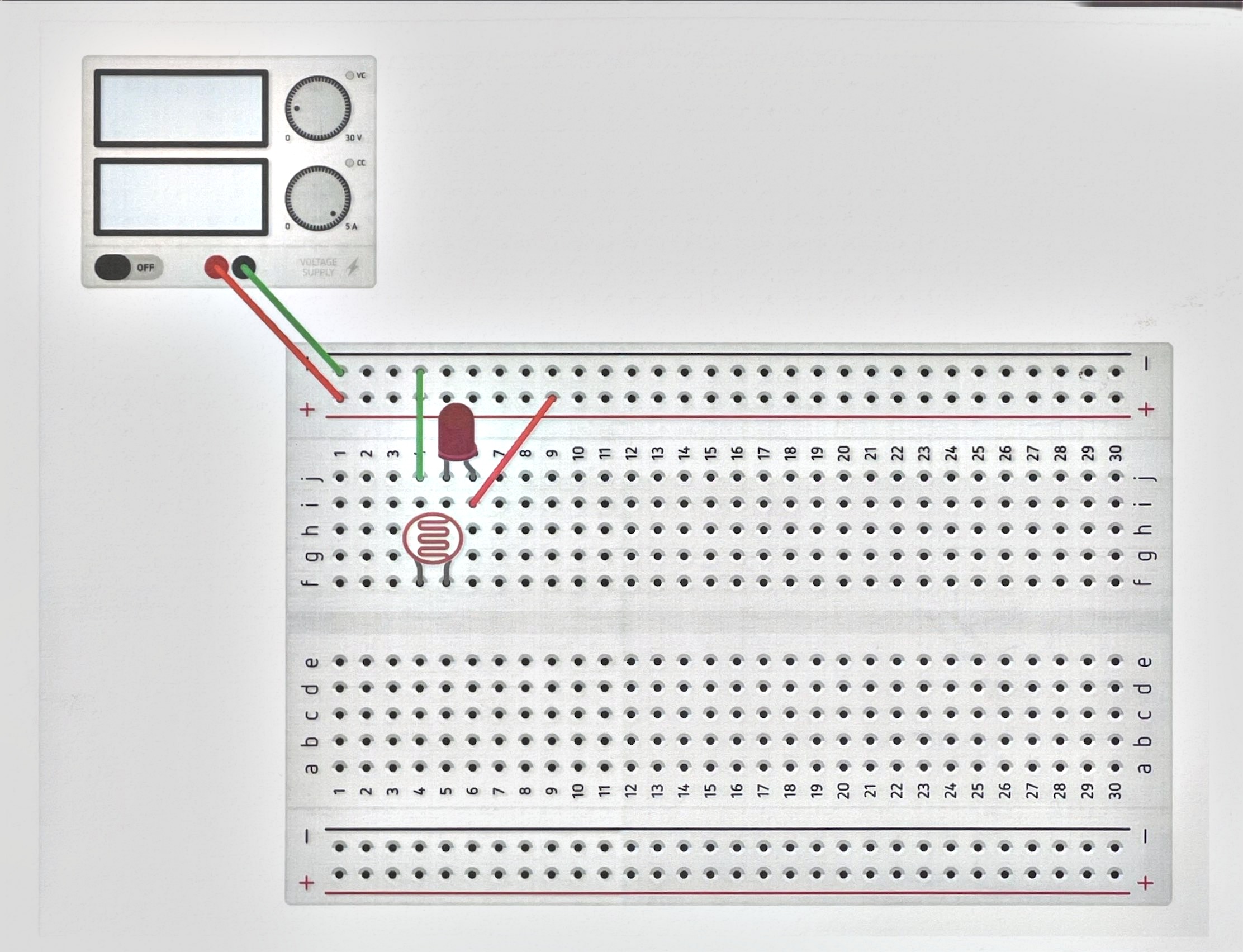
A resistor the world turns
A potentiometer, from a couple of lessons back, is a resistor a person turns with a knob. A photoresistor is the same idea with a different hand on the dial: its resistance changes with the light falling on it, higher in the dark, lower in bright light. Wire it in place of a fixed resistor and you’ve built a light sensor out of a component with no electronics inside it at all.
Cover the photoresistor and watch the LED’s brightness change, the same way turning the potentiometer changed brightness in lesson 2. Nothing about the math is different — it’s still current set by resistance, Ohm’s law from lesson 1 still holds at every instant. The only thing that changed is who, or what, is adjusting the resistance: you, with a knob; the room, with its light level.
That’s the last piece of the pattern this whole sequence has been building: a switch is a break in the loop a person controls. A photoresistor is a break in the loop the world controls. Next lesson, you’ll build one a program controls.
Questions
- If you wanted the LED to get brighter as the room gets darker instead of dimmer, what would need to change in the circuit?